Tag Archives: Telcom Act of 1996

Is Your Iceberg Melting?

94This past week was another tough one for the wonderful people who work in radio. Most people who get into radio do it because they’ve caught the “radio bug” and the work becomes their life’s passion. I know that’s how it is for me.

When I caught the “Radio Bug”

From my earliest years, I knew what I wanted my life’s work to be. I built a radio station in my parent’s basement and broadcast to the neighborhood (about a 3-block radius) on both the AM and FM bands using transmitters I bought from Radio Shack.

When I started high school, I earned my 3rd Class Radio/Telephone Operator’s License, Broadcast Endorsed from the Federal Communications Commission in Boston. I wasn’t old enough to work, so I had to get a Massachusetts Work Permit. They didn’t have a category for disc jockey, so they branded me as “talent.” (I never told them I had to take meter readings every half hour in front of a transmitter that put out 1,000-watts of electromagnetic power. If I had, they would never have given me my work permit.)

College Radio

In college, it was radio that paid for my bachelors and masters degrees. I took my college’s carrier current radio station, got an FM broadcast license and was the first general manager.

Radio was in my blood.

RIF’s

After the Telcom Act of 1996, radio began its road down the consolidation path funded by Wall Street. It was during this period of time a new acronym would come into radio’s every day lexicon, RIF’s, or Reduction In Force. In other words, people were being terminated in huge numbers.

This past week, I sadly read about another round of RIF’s taking place among our country’s biggest owners/operators of radio stations. It breaks my heart.

RIF’s from the Manager’s Perspective

We all feel sorry for those that have unexpectedly lost their job. What we often don’t read about is the perspective from the other side of the desk, what the management is going through when these decisions are made at corporate.

I lived through it in 2009 as a Clear Channel Market Manager.

It’s NOT FUN.

With each corporate meeting, I would come home with a flash drive that could not be opened until a specific date/time with who I would have to RIF next.

I RIF’d my entire news and promotions departments.

I RIF’d DJ’s and PD’s.

I RIF’d my national sales manager, my director of sales and local sales managers. With each round of RIF’s I got more hats to wear. The work still needed to be done, it didn’t go away with each round of RIF’s.

I hated my job.

Then my regional manager showed up unannounced and RIF’d me.

His manager showed up after he had RIF’d all of his designated market managers and RIF’d him.

The company president RIF’d the senior regional managers.

Then the CEO RIF’d the president.

It was not a happy time, but believe it or not, being RIF’d to me was better than being one of those that found themselves with more and more hats to wear, with more and more responsibility, without a penny more in pay.

There were many folks who told me to find another line of work, but they didn’t know that broadcasting was the only thing I ever wanted to do.

Except for one other thing, teaching and mentoring the next generation.

My education was in teaching. Both my bachelors and masters degrees were in teaching.  My best teachers were those who worked in the field first and then came into the classroom to teach.

Paying It Forward

My long term goal was always to one day teach at a college or university the very things I had done all of my professional life.

My big opportunity presented itself at Western Kentucky University’s School of Journalism & Broadcasting in 2010.

When I was RIF’d by my regional manager, I had met or exceeded every goal I had been given and was paid bonuses for my accomplishments. I was even named one of radio’s Best Managers by RADIO INK magazine. The issue of the magazine with me in it came out almost the day after I was RIF’d. Funny how life is: good things happening at the same moment as bad.

One Door Closed, Another Door Opened

When my last management job came to an abrupt end with Clear Channel, my broadcast professorship door opened at WKU.

Let me tell you, going from being a radio market manager to broadcast professor is a steep learning curve. But with the help of Charles H. Warner at NYU, John Parikhal of Joint Communications and others, I successfully made the transition and became successful at teaching. In fact, my new broadcasting educational work branch opened my eyes to all kinds of new and exciting learning opportunities.

I started this BLOG and a column for RADIO WORLD magazine during this time.

Those have lead to numerous invitations to appear on podcasts, Vlogs, articles, and broadcast interviews with others sharing stories of my work and experiences.

I’ve done research on the radio industry and their employment needs in the 21st Century. I’ve presented panels every year at the national conference in Las Vegas as well as been an invited broadcast expert on many panels at both BEA and NAB.

I’ve presented seminars at state broadcast associations and done training sessions for broadcast companies.

In short, I’ve been more active in broadcasting on so many levels than I ever was as a radio manager.  And I’ve loved every minute of it.

But I’m not going to candy coat what’s happening, not only in radio but in all ad supported media. It’s a revolution.  Not an evolution.

In revolutions the first thing that happens is destruction of the old. We’re still living through that period right now and it’s not fun. I get it.

Our Iceberg Is Melting

Back in 2008, many people picked up a copy of Ken Blanchard’s book “Who Moved My Cheese?”  I know I did. It’s a great read.

But maybe the book everyone in broadcasting should be reading today is “Our Iceberg Is Melting” by John Kotter. Kotter is an award winning author from the Harvard Business School.

Like Blanchard and Johnson’s Cheese book, Kotter writes a simple fable about doing well in an ever-changing world.

The fable is about penguins in Antarctica that discover a potentially devastating problem to their home – an iceberg – and it’s melting away.

It’s a story that will resonate with anyone in broadcasting today.

Read about how the penguins handle their challenge a great deal better than many broadcasters are doing today. Kotter’s book walks you through the eight steps needed to produce positive change in any group.  You will not only enjoy the read, but will be guided with valuable insights to deal with our 21st Century world that is moving faster and faster every day.

The Big Take Away

When corporate, middle management and all employees are on the same page with regards to change, it is amazing what can happen, despite adverse conditions.

These are lessons for people who already are in broadcasting, for broadcast students, enlightened colleges are already teaching the concepts, skills and providing the tools that will be needed going forward. My students know that the future is not bleak. They understand the history of broadcasting that brought us to where things are today and they are as pumped as you and I were when we were their age to craft the future of broadcasting in the new century.

I’m excited.

They’re excited.

The best is yet to be.


19 Comments

Filed under Education, Mentor, Radio, Sales

The Question Radio Itself Has Yet to Answer

86That was the subject of an email I received from a reader of my blog recently. The writer went on to eloquently state why he felt the way he did, even citing articles on the topic. He had my interest and I asked him if we could speak on the phone.

The BIG Question

This reader’s (who asked to be kept anonymous) big question was “What can radio do that other media can’t?”

And it’s a very good question.

In 2017 when many are using the internet for things that only radio could provide in the past, is radio’s future being the poor man’s smartphone, tablet or iPod when it could be more?

“NPR and SiriusXM, in addition to the new exploding podcast marketplace, have had no trouble creating personalities and programs,” but my reader writes “why does FM commercial radio continue to stick with playing the hits, past and present, at the expense of personalities, thinking it will make them money when the biggest radio companies have trouble paying off debts on the stations they seem to have paid too much for?”

Well it was a well-known fact all of my radio life that you make money in radio at the time you buy a radio station. Buying it right makes all the difference. And those big radio companies went on a buying spree using other people’s money (Wall Street) and it’s much like student loan debt, no one worries how much debt they’ve accumulated until they are asked to replay it.

Is Local Radio Local Anymore?

My reader quotes Westwood One’s Chief Insights Officer Pierre Bouvard from an AdExchanger interview as saying “A local radio station gives you traffic, sports, weather, great music, funny DJs and talks about your town,” he said. “Spotify has these robotic music playlists, which are awesome, but there’s no one telling you what happened at the Giants game last night.”

My reader says Pierre (who was my first Arbitron representative back in the 80s) makes a good point, but wonders if Pierre ever took the time to hear what passes for much of local radio these days. My reader feels that much of today’s FM radio stations do a combination of great music and robotic, Spotify-ish playlists, and relatively little in the way of “traffic, sports, weather…funny DJs and talk about your town” stuff.

Sadly, I’ve heard similar things said at radio meetings where the person starts off by saying “now don’t quote me on this, but…”

TELCOM Act of 1996

It was President Bill Clinton who signed the Telcom Act of 1996. That act was supposed to bring competition to the phone and cable television industries thereby lowering costs of each to the consumer. While that didn’t happen quickly (some might wonder if it ever did) it did cause the quick consolidation of the radio and TV industries. We went from a country where the largest radio operator could own 12AM-12FM-12TV stations to virtually whatever their pocketbook could afford. And with Wall Street Bankers waiting in the wings, what a company could afford was a lot.

Low Power FM & Translators

For the non-radio folks who read this blog, Low Power FM signals and Translator signals are virtually the same thing, with the exception being that Low Power FM stations originate programming and translators don’t. Both are received over the air on the FM radio dial. Both have increased the number of FM signals on-the-air in America today.

The latest FCC (Federal Communications Commission) report as of the end of December 2016 shows that there were 4,669 AM radio stations on the air in America. Over on the FM dial, 16,783 signals now beat the airwaves (FM, FM educational, translators and low power FM).

To put things in perspective, at a time in America’s radio history when the number of FM signals equaled the number of AM signals on the air, 75% of all radio listening was to FM. So you can only imagine what it’s like today.

93% of Americans 12+ are reached weekly by AM/FM radio says Nielsen.

So while the Telcom Act of 96 caused radio to consolidate under fewer owners who own more stations, adding to the signal overload was the advent of low power FM and translator signals. So much to program and no one home to do the work.

Enter computers, voice tracking, and syndication. This is same computer technology that is employed by Pandora, Spotify, Radio Tunes, SoundCloud and many others.

When TV Challenged Radio

In 1952 TV was born again. It was birthed just before World War II but the war years put broadcast radio/TV development on hold. After the war ended, things began to ramp up quickly for TV.

In 1953, Elmo Ellis was hired to fix 750AM – WSB in Atlanta. Ellis would write about “Removing the Rust from Radio Programming” for Broadcasting/Telecasting (now called Broadcasting and Cable magazine).

One of the points Mr. Ellis made was that a stack of records and a turntable do not a radio station make, though many broadcasters persisted in that very belief.

It was the very same philosophy I employed when I launched a “Music of YOUR Life” radio station. I felt that to be successful, you needed more than just Al Ham’s music list, you needed the personalities that complimented the music.

Both my reader and I are in complete agreement in that a radio station is more than just a song list.

Less Is More

The problem today is that with the “land rush” by broadcasters to own as many signals as they can, we have seen our country’s biggest broadcasters put themselves into a debt situation they cannot get out of and smaller broadcasters have signals and streams to manage but not the revenues to properly execute them.

If we go back to the beginning of broadcasting in America, we see that the FRC (Federal Radio Commission) that predated the current FCC felt that quality over quantity of radio stations should be the rule of measure. By limiting the number of stations, the FRC was attempting to insure the content of those stations on the air would be of the highest quality and also by limiting the number of stations; the advertising revenue that is the life blood of free over-the-air radio could be sustained.

What Can Radio Do That Other Media Can’t?

This brings me back to the question my reader originally posed and asked me to answer.

But before I do, I’m going throw that question out to my other readers – to date over 80,000 from all over the world – to weigh in with their thoughts.

What do you feel radio can do that other media can’t?

Is any radio station you know of doing it right now?

Is this a sustainable future for over-the-air radio?

I’m looking forward to reading your thoughts.

50 Comments

Filed under Education, Mentor, Radio, Sales

It Was the Best of Times & the Worst of Times

65Radio broadcasting began in the “Roaring 20s.” A time in America that saw the first tabloid newspaper appear. Reader’s Digest, New Yorker Magazine, Time Magazine would also be born right along with radio. It was a time of unprecedented economic prosperity and social change. It was a time of a strong backlash of racism, fear of immigration and morality.

The 1920s and the world we are living in today are not all that dissimilar. Today, the wealth inequality is greater than it was in the early 1920s.

And just like those times, almost a hundred years ago, that gave birth to radio we are living in times that are giving birth to the “Internet of Things.”

Immigration: Then & Now

After World War One ended, America got tough on immigration. The most stringent set of immigration restrictions in American history was enacted with “The National Origins Act of 1924.” It restricted the flow of immigrants from Europe (and elsewhere) to less than 200,000 per year. This fear of immigrants reignited the Ku Klux Klan. The KKK membership saw its membership rise to a new high in 1928. Reformers advocated for a more militant, less conciliatory stance.

Today the battle rages on over building a wall between Mexico and the United States and over immigration of Muslims.

Women’s Rights

While women had won the right to vote, they still couldn’t go to college and most professions still excluded women. While women could now own property, they couldn’t establish credit with a bank or get backing for a business venture.

Many felt that the only thing that changed in America when women were given the power to vote was prohibition; the 18th Amendment to the Constitution.

War on Illegal Substances

So while the United States tried to control alcohol in the 20s and failed, today we find America battling another illegal substance battle, marijuana, with much the same results.

People will find a way to do something they really want to do.

Modern Mass Media

The 20s ushered in the first decade of modern mass media. American-made films not only captured the attention of American audiences, but the whole world. Every city would have at least one movie house by the end of the decade.

Because the movies were silent, musicians were in high demand for the movies. And because radio was all live, it too needed musicians to perform during each broadcast day.

Radio Jingles

The 20s also saw advertising agencies now develop departments devoted to the creation of radio advertising and soon the commercial radio jingle was born.

The Worst of Times

The Roaring 20s would end with Black Tuesday, October 29, 1929, the stock market crash and the beginning of the Great Depression.

While this decade created favorable conditions for big business to prosper, the alliance of government and industry left labor unions out in the cold.

It was these times that radio was born.

The Great Recession of 2008 would be the environment that would see the Internet of Things born.

Today’s Big Regulatory Difference

The big difference I see today for radio versus its toddler years is how it is regulated. The Radio Act of 1927  provided the foundation for all broadcast regulation right up until today. While more Acts were passed and made law over the years, the basics remain much the same as when they were first made law.

Some of the key provisions in the original Act that we’ve deviated from today are:

  • Limiting the number of broadcasters to foster higher quality radio broadcasts versus having more stations of poor or mediocre qualities
  • Radio broadcasters would operate in the “public interest, convenience and necessity”
  • Radio would be a regulated medium to assure high quality and operating in the public interest
  • Radio would be commercial and privately owned (a condition that made radio broadcasting in the USA different from every other country in the world)

Those who complain that radio isn’t like it used to be only need look at how broadcast regulations have been changed over the past century; the biggest change being the Telcom Act of 1996.

Utopian Hopes, Dystopian Fears

When commercial radio was born in 1920, it was hoped that it would bring about national unity. Those utopian hopes and dystopian fears would fall basically into four different areas.

  1. Radio would create a physical unity in the country bringing people together as one
  2. Radio would bring about a new cultural unity as Americans
  3. Radio would make America a one language nation providing linguistic unity
  4. Radio would bring about institutional unity where everyone wanted the same things and held the same vision

I will let you draw your own conclusions on the success or failure of these goals for radio.

Internet of Things

Broadcasting in America started out as a government-assisted oligopoly. The internet did too. Both, I would argue, now fall into the unlimited category. While I realize this is definitely true for the internet, I know others would quickly point out the limited amount of spectrum for AM and FM radio broadcasting. However, with the growth of FM translators and LPFM stations, it feels like it’s unlimited.

The original system of a government preferred broadcasting system is being challenged today by the Internet of Things.

And covered in dust, is the original fundamental principle of operating in the public interest, convenience and necessity and not merely for maximum profits.

12 Comments

Filed under Education, Mentor, Radio, Sales, Uncategorized

Don’t Let Radio End Up Like Yahoo!

49I just finished listening to Jason Jennings’ podcast about how Yahoo went from being a company worth $120 Billion to its sale to Verizon for $4.8 Billion. I think the wisdom that Jason shared is very applicable to the radio industry’s journey through consolidation since the Telcom Act of 1996.

Jason says the selling of Yahoo is like a train wreck; you don’t want to look, but you just can’t help yourself. I know many who’ve said similar things as Wall Street invaded radio with its goal of “increasing shareholder value.”

So how can radio learn from Yahoo’s mistakes? What are the lessons Jason shared that apply to radio? Let me share with you the Top 5 Lessons of Yahoo:

#1) Know What You’re All About

Yahoo never really defined itself and the revolving door of CEOs contributed to this with each one bringing a different vision – or no vision – to Yahoo. Or as Jason puts it, the company didn’t have a purpose; they never knew what they were all about.

As radio was deregulated and its original mission of serving the public interest, convenience and necessity was abandoned, nothing replaced radio’s reason for existing except for “increasing shareholder value.” Not surprising as radio people were replaced by Wall Street investors.

#2) Have a Set of Guiding Principles

Radio’s guiding principles were first established by the FRC (Federal Radio Commission) and then by the FCC (Federal Communications Commission). Under President Ronald Reagan – and his government is best that governs least approach – radio’s deregulation began. President Bill Clinton would open the flood gates of consolidation with his signing of the Telcom Act of 1996.

With no guiding principles, investors were free to move in all directions; and they did, buying up not just radio stations but many of its manufacturers and service providers for radio.

It’s like the old saying, if you don’t know where you want to go, any road will take you there.

#3) Using a Business like a Personal Piggy Bank

Radio investors and many top radio executives began using radio as a personal piggy bank, only taking care of themselves and focusing on the immediate quarter with no long term vision, strategy or investment. Too many just lined their pockets and left.

#4) Trying to Be All Things to All People

Jason says “great companies stick to their knitting. You can’t be all things to all people.”

Radio was originally about serving their community of license via over-the-air broadcasting. It delivered local news, local sports, local community events, local bands and more by local radio personalities who lived in the communities they served. It was focused like a laser beam on local, local, local.

#5) Don’t Copy the Competition

Radio today is trying to copy Pandora, Spotify, Apple Music and others. Radio today is trying to also copy YouTube, Facebook, Pinterest, Twitter and SnapChat. Radio is trying to copy just about every other business advertising model and without any guiding principles has been economically treading water.

Yahoo’s SVP Brad Garlinghouse wrote his infamous “Peanut Butter Memo” in October of 2006 that pleaded with the company to narrow its focus and clarify its vision.

Brad felt that Yahoo was spreading its resources too thinly. Business Insider recently wrote “This internal memo from 10-years ago shows Yahoo still hasn’t solved its biggest problem.”

If Yahoo had a culture problem, radio by way of mass consolidation had an even bigger one. First, as Wall Street money flowed in and radio stations were bought up, each of those stations represented its own culture that would need to merge into a larger culture. Then these new larger radio groups would try to change the culture from a local scope to a national scope. National radio personalities like Ryan Seacrest, Rush Limbaugh and many others would replace local personalities. National radio contests would replace local ones. Live and local for the most part would soon only appear in the history books on radio.

Culture is created at the top. Over the last twenty-years, radio’s consolidation has seen a revolving door of top leadership. The culture of radio has been a moving target for both industry professionals and listeners alike. Culture is built over time. There is no “quick fix” for building culture.

Absent a company culture, what fills the vacuum is one of everyone for themselves.

Now twenty-years later, there are signs of new growth as people who believe in live and local, and operating in the public interest, convenience and necessity are entering the business.

In many small markets, this way of operating never got sucked into the vortex of consolidation.

Even some of our country’s biggest radio companies are focused on getting back to the core principles radio was built upon.

Radio, the first broadcast transmission system to reach a mass audience, almost 100-years later is still the leading way to reach a mass audience.

37 Comments

Filed under Education, Mentor, Radio, Sales, Uncategorized

What We Have Here, Is a Failure to Embrace Complexity

42The world we live in today is a complex place. The KISS operational style seems like it would be a good idea. (KISS = Keep It Simple Stupid) But maybe not.
Turns out in a complex world, being agile is more importance than being efficient. Being efficient kills innovation. Innovation today is the primary driver of building value and creating value is one of the basic reasons for any organization to exist.

Managing Complexity is a 21st Century Skill

People who can manage complexity will be the leaders of the future. Managing a radio station was complex due to the fact that radio has two customers, which want totally opposite things. One customer is the radio listener. This customer wants information and entertainment. This customer usually isn’t fond of commercials. The other customer is the radio advertiser. Anytime their ad isn’t dominating the airwaves and driving consumers into their store is a moment the radio station isn’t doing its job. To add to this complexity are the talented people needed to service both of these customers. Air personalities that attract listeners and sales folks that service advertisers.

Consolidation & Complexity

As the radio industry began consolidating after the Telcom Act of 1996, the traditional thinking of protecting margins was amplified. This resulted in reducing labor costs. RIFs became commonplace (RIF = Reduction In Force). For those that were left wages became stagnant, little money was invested in training and the number of people left in the workforce was reduced to a bare minimum.

The problem is, when you have low paid, poorly trained and overworked people, your operation lacks new and innovative ideas that can improve the business. When the only ideas that are introduced come from the tippy top, they rarely connect with the challenges seen at the front line.

Zeynep Ton writes in her book The Good Jobs Strategy about a discount retailer that took a different approach to their operation than most companies when the great recession of 2008 struck the world. Rather than cut wages or reduce staff, Ton says they asked their employees to contribute ideas. The result was that this company managed to reduce prices to their customers by ten percent while increasing their market share from 15% to 20% from 2008 to 2012.

Herb Kelleher writes in his book NUTS! about how Southwest Airlines created a culture where employees are treated as the company’s number one asset. Southwest does a number of things to benefit its employees, including such programs as profit-sharing and empowering employees to make decisions. This empowerment during the period when oil prices hit a high of $145 per barrel in 2008 saw the Southwest pilots taking the initiative to plot more efficient flying altitudes and work with ground crews to get in and out of the gates quicker to control the Southwest ticket prices and not lay off any people while maintaining a positive profit margin. These actions did not come from the corporate home office but from employees in the field.

What to Do When You Have Maximized Efficiency

Let’s face it; the ability for any radio operator today to squeeze out any more profit through efficiency is over. Radio consultant George Johns puts it this way: “Radio today is in the no business, it has no money, no time and no people.”

So what’s the answer? Collaboration.

The radio companies of the 21st Century will need to develop the ability to make collaboration a competitive advantage. The game has changed from what you own and control to what you can access. Access happens via platforms. Radio needs to create platforms that bring consumers and producers together, much like the Apple App store does globally, but locally for their service area.

Radio needs to find a way to attract listeners by causing them to be fearful of missing something if they’re not listening while directing them to local places via platforms they control that can fulfill their wants and needs on demand.

In other words, radio needs to “think different.”

13 Comments

Filed under Education, Mentor, Radio, Sales, Uncategorized

My 100th Blog Post

40Today is a milestone of sorts for me. It marks my 100th blog post since beginning my blog. Also notable since my blog has long passed the threshold of four months, the period of time most new bloggers quit blogging.

What Have I Learned So Far

Reflecting on my blogging journey on the way to my 100th post, I learned that running out of material to blog about was not my biggest problem, but rather having files of ideas and issues I wanted to address and not having the time to develop them due to more pressing issues bursting onto the scene.

I learned that blogging was more about organizing my own thoughts than if anyone else read them or reacted to them.

I learned that blogging connects you with incredibly talented people all over the world that you never would have met other than by doing a weekly blog.

I learned that blogging is fun.

My Biggest Hits

Two blog posts in particular standout as being noteworthy. It’s funny, because they are not the ones I might have thought would have gone viral.

The first one was me venting my spleen about the loss of great air personalities in my post entitled “We Never Called It Content.” What troubled me was the “forced retirement” of some iconic air personalities and that the radio industry wasn’t valuing the relationships that such personalities owned with their audiences. That short-term revenue gains due to expense reduction were at the peril of longer term audience erosion.

As the old farmers used to say “Anyone can tear down a barn, but it takes a craftsman to build one.”

The other blog post that would see over 3,700 reads in a single day was “The Day the ‘Dumbest Idea’ Invaded the Radio Industry.” This post grew from an article in Forbes I had read by Steve Denning. The “dumbest idea” was that of increasing shareholder value. What I realized was that when the Telcom Act of 1996 was signed into law by President William Jefferson Clinton it opened the doors of the radio industry to Wall Street. Wall Street would bring their philosophy of “increasing shareholder value” to broadcasting. The effects of this modus operandi would be as devastating to radio as it had been to every other industry it was used in. Sadly it doesn’t have to be that way and we see that privately held radio companies avoid this metric and as a result are doing well by both their stakeholders as well as the communities they are licensed to serve.

What’s Next?

So next week, I will begin my next one hundred blog posts. I have lots of ideas about what’s going on in our media world to reflect on, research and share with you.

The commercial radio industry is only about three and half years away from celebrating its 100th birthday in 2020. The year 2020 should prove to be interesting for so many reasons beyond just radio, TV or media, for the prognosticators are envisioning so many changes in all aspects of our world.

So I will end my 100th blog post much like the singing group The Statler Brothers used to say at the end of their television show….

“Don’t go anywhere, because we ain’t even started yet.”

8 Comments

Filed under Education, Mentor, Radio, Sales, Uncategorized

Radio is Going to HAL

22You remember HAL? The HAL 9000 is a fictional character from Arthur C. Clarke’s Space Odyssey series. HAL’s name stood for Heuristically programmed Algorithmic computer. HAL was the future of artificial intelligence. HAL always spoke in a soft, calm voice and in a conversational manner. HAL was born in the 90s according to Clarke.
I remember computerizing my radio station’s traffic and billing system around that same time. Computers would quickly invade every part of my radio station operations. It was scary. I remember looking at that computer box and thinking, if that darn thing “dies” there goes the whole enchilada. It wasn’t like losing a phonograph needle or a cart machine or a CD player. Computers changed the game to an all or nothing model. Computers also introduced another concept foreign to radio broadcasters, planned replacement schedules while they were still fully operational. Radio always used to run every piece of equipment until it could run no more. But you couldn’t play that game with computers.

More Dead Air

Programming great, George Johns, recently posted this thought on his blog: “Is it just me or are there a lot more pauses on the radio now than there was when we were using carts.”   And I wrote back to Geo that I noticed the same thing. I figured it was because today, the people charged with running radio stations are not listening to them. Not because they don’t want to, but because they can’t. They are busy – very busy – multi-tasking.

When computers were introduced into radio, I thought it would be great because it would allow air talent to spend more time working on show prep, interacting with the listeners and being focused on their show and not about cuing up records, pulling carts etc. For small market radio stations, it meant that air talent would have an engineer just like the big city radio stations had always had for their air talent. But that’s not what happened.

The radio industry had a different idea in mind. Computers would allow air talent to do more.

After the Telcom Act of 1996, the radio industry began to rapidly consolidate. General Managers became Market Managers. (GMs usually were charged with overseeing an AM/FM broadcast property. MMs would oversee multiple AMs, FMs and in many cases, multiple markets of AMs & FMs.) Computers were quickly seen as a way to do more with less. More work with less people that is.

Multi-tasking Kills Your Brain

Air personalities now could be on multiple radio stations at the same time. They could multi-task. The unfortunate part of this is research now shows that multi-tasking will kill your brain. Turns out our brains were not built to multi-task.

MIT neuroscientist Earl Miller quoted in Inc. magazine says that our brains are “not wired to multi-task well and when people think they are multi-tasking, they are actually just switching from one task to another very rapidly. And every time they do, there’s a cognitive cost.” This constant switching actually produces bad brain habits. Worse, multi-tasking actually lowers your work quality and your efficiency. It actually lowers a person’s IQ like if you were to skip sleeping or use drugs. So if you wonder why today’s air talent isn’t connecting with listeners like they used to, it really isn’t their fault. The deck has been stacked against them by an industry that is using computers and voice tracking to enable their air talent to multi-task. Multi-tasking is not a skill to add to resume. It’s a bad habit to quit doing.

Computers Change College Radio

Erik O’Brien wrote in an article in Radio Survivor about how automation was introduced into his college radio station and how it changed the way college radio was now done and not for the better in his opinion.

KUTE adopted the ENCO DAD radio automation software. What had been a college radio station comprised of student radio enthusiasts, experimenting, having fun – sometimes producing radio greatness and sometimes not – would turn into a more “professional” operation through the use of computerized software. A radio station that had live radio personalities around the clock could now operate without any DJs.

Everything that goes on the air goes through DAD (Digital Audio Delivery). If it’s not in the computer, it won’t go on-the-air. This standardization now allowed for KUTE to begin monetizing their programming. KUTE had an AM signal, licensed by the FCC, but when the transmitter broke down and there was no money to repair it, it became an online only station. Now it was not subject to FCC rules that embraced a community-driven model of radio. It also could now support advertising that could be scheduled and aired that its non-commercial FCC license did not allow.

The new computerized system meant the station was now stable and standardized and predictable. Except when the computer loaded programs didn’t air and other operator errors would plague the station’s on-air sound. What used to be a fun college experience now was a stressful chore.

The Bottom Line

What it all comes down to, whether we’re talking about college radio or commercial radio, is what value are we offering to our listeners by the technology we employ? What do we want the listener experience to be? If we use technology to allow our air talent to be more focused on the station’s mission, radio will be great but if we use it in other ways, probably not.

9 Comments

Filed under Education, Mentor, Radio, Sales, Uncategorized

The Day the “Dumbest Idea” Invaded the Radio Industry

shareholder valueLast week I wrote about killing the goose that lays the golden eggs. It was my way of comparing the Aesop fable to the world of American radio. It got a lot of discussion. But I felt that while I touched on how radio operators twenty years ago wanted to harvest all the golden eggs immediately versus waiting to get one each day, by virtue of a last minute insertion into the Telcom Act of 1996 that basically removed the ownership caps on radio, there was – as Paul Harvey used to intone – ‘the rest of the story’ to be told.

The rest of the story involves “the dumbest idea.” I grew up about a decade after World War Two ended. This was the period when America enjoyed an extended period of economic growth and a shared prosperity. By “shared prosperity” I mean it was a time when the workers who produced a product or service shared in the profits produced by the company. Managers and workers would see their income grow together. As everyone’s pay increased, there was more discretionary income to spend. This was the rise of the middle class in America. All boats were rising with the economic tide.

In 1968, I started on-the-air at one of my hometown radio stations while in the 10th grade in high school. I was paid the minimum wage; $1.60 per hour. Did you know that 1968 was the year when someone making the minimum wage had the most buying power for that rate of pay? The equivalent in 2012 dollars is $10.34 per hour. So what happened?

Somewhere in the 1970s things changed. Firms began to focus on themselves. The productivity gains produced by the workers were no longer shared with the workers. Since no one complained, this new way of doing business continued.

The 1980s really saw this new operational style take hold. And as it did, incomes for the middle class stagnated. When the middle class incomes stop growing, the ramifications on the rest of the economy are magnified. Workers no longer have discretionary income to spend. This was initially covered up by women entering the workforce producing two wage-earner incomes. Then when that ran its course, credit cards, second mortgages would keep the party going under false pretenses.

Today we are in a vicious cycle of decline.

What changed in the 1970s was a new idea about what metric should be used to measure the success of a business. Before this new idea was born, Peter Drucker’s measure was the rule. The purpose of a business, said Drucker, was to create a customer. But that went out with leisure suits, the new crop of business wizards would proclaim. What replaced it was something that even GE’s Jack Welch has called “the dumbest idea in the world.”

What was this dumb idea? Increasing shareholder value.

In an effort to offset declining profits and performance, a new operating modus operandi was conceived that the purpose of a corporation is to maximize shareholder value. To make sure the captains of industry got the message, boards of directors would change their compensation packages to cause these business leaders to focus on increasing the company’s stock price. What could possibly go wrong?

Everything!

The concept was embraced by both America’s business schools as well as industry. Unfortunately, the new policy not only didn’t solve the problem it was supposed to address but by unintended consequences created a myriad of new problems no one foresaw.

Tell me if any of these “unintended consequences” sound familiar to you: short-term decision making, relentless cost cutting, staff reductions (RIFs), less investment in the business, virtually no innovation, low workforce morale, no raises in pay, reduced benefits, non-stop mergers, increased debt, lost ability to compete, declining R.O.I., and economic stagnation. I’m sure you can add to this list based on your own experiences. For a more detailed look at this, you should read Steve Denning’s “Why ‘The System’ Is Rigged And The U.S. Electorate Is Angry,” the inspiration behind today’s blog post.

So twenty years ago, in 1996, President Bill Clinton signed into law the Telcom Act of 1996. This would bring “the dumbest idea in the world” to the radio industry. Wall Street jumped into the new shiny investment opportunity; radio. Everything that every other industry was experiencing from this new operational style was now rearing its ugly head in the broadcasting industry. All with the same negative impacts.

Not all organizations adopted this dumb idea of operating. They stuck with Drucker’s rule. And it’s the same with the radio industry. The smaller radio operations do operate differently. Their success has others sitting up and taking notice.

However, most organizations – and not just in broadcasting – are still in denial. The evaporating middle class is not good for an industry that lives off of advertising. Advertising is pitched to the masses who are the consumers that drive over seventy percent of the American economy. I wrote about the future of ad supported media last year after I read Thomas Piketty’s book “Capital in the 21st Century.” You can read that blog post here.

Based on the tumultuous presidential election season we’ve seen so far, it would appear that the American society has awakened and is now “as mad as hell and not going to take it anymore.” Cue Howard Beal here.

Steve Denning writes: “We are now at an ‘emperor has no clothes’ moment.” It’s now clear that this way is not working and is not only leading to systemic value destruction but an economy that no longer works for the middle class.

If we’ve ever needed real leadership in America, it’s now — and from all directions.

29 Comments

Filed under Education, Mentor, Radio, Sales, Uncategorized

Are We Killing the Golden Goose?

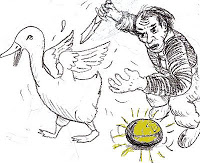
25Do you remember Aesop’s fable of the goose that laid the gold eggs? Let me refresh your memory of this tale. It’s about a farmer that was poor. One day he makes a startling discovery when he finds a golden egg in the nest of his pet goose. Skeptical at first, he has the egg tested and finds that it is indeed made of pure gold. Even more amazing, each day this farmer awakes to find that his goose has laid another golden egg. In very short order, this poor farmer becomes fabulously wealthy. But then his wealth brings greed and impatience. No longer satisfied with just one golden egg per day, the farmer cuts open his goose to harvest all of its golden eggs at once only to find the goose is empty inside. With a now dead goose, there will be no more golden eggs laid.

In remembering this fable, it sounded so familiar to the world of radio broadcasting. A radio station was like a wonderful “goose” that laid daily “golden eggs” for many an owner. It was an industry joke that having an FCC broadcast license was like having a license to print money. It was “golden.”

But broadcasters not wishing to wait for each day’s golden egg, cut open their goose with the Telcom Act of 1996. Twenty years ago, this act deregulated radio and now owners, like the farmer cutting open his goose to get all the eggs at once, now could own as many radio stations as they basically wished.

And how did that work out? Not much better than what the farmer discovered.

The moral of Aesop’s fable is if you focus only on the golden eggs and neglect the goose that lays them, you will soon be without the very asset that produces the golden eggs.

The radio industry’s quest for short-term returns, or results, took their free FCC licenses and ruined them by not maintaining the balance between the production of desired results and the production capacity of the asset.

Aesop’s fable is the very principle of effectiveness. It’s a natural law. Like gravity, you don’t have to believe in it or understand its principles, but you can never escape its effects.

Radio broadcasters probably saw the moral of the fable being the more geese you own, the more spots you add to the hour, the more effective your R.O.I. (Return On Investment) will be. But ironically, it was the principle of “Less Is More” that in the end rules the day.

To be truly effective, you need to maintain the balance of what is produced (golden eggs/revenue) and the producing asset (your goose/radio station).

Stephen Covey wrote extensively about all of this in his book “The Seven Habits of Highly Effective People.”

When people fail to respect the P/PC Balance in their use of physical assets in organizations, they decrease organizational effectiveness and often leave others with dying geese.”

-Stephen Covey

One could certainly make that case for two of America’s largest radio broadcasters today. They are reaping the results of those who’ve gone before them who’ve in essence liquidated the asset, before they took over and now the accounting system appears to show that they are not performing at the level of their predecessors. But is that really the case? Did they in reality inherit a very sick goose when they took over? The debt problem say many who are more schooled in this area of high finance than I, will probably be addressed with a re-set. And once that happens, it will come back to the people of radio.

Covey says to “always treat your employees exactly the way you want them to treat your best customers.” Herb Kelleher at Southwest Airlines built his company on this very Covey principle.

Covey puts it this way: “You can buy a person’s hand, but you can’t buy his heart. His heart is where his enthusiasm, his loyalty is. You can buy his back, but you can buy his brain. That’s where his creativity is, his ingenuity, his resourcefulness.”

The bottom line is the future of radio will be determined by the vision of the people leading the radio industry. It will also be determined by the hiring decisions they make going forward.

“If you hire people just because they can do a job,

they’ll work for your money.

But if you hire people who believe what you believe,

they’ll work for you with blood and sweat and tears.”

-Simon Sinek

13 Comments

Filed under Education, Mentor, Radio, Sales, Uncategorized

What if…

I had the opportunity to sit in on a webinar on “The Creative Economy” that is considered to be the direction the future of business is headed in compared to the traditional business methods of the past. What is meant by the term “The Creative Economy?” It’s one where business revolves around the customer versus the past where the customer revolved around the business.

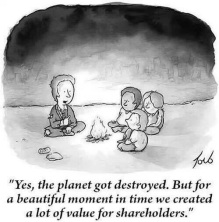
The Creative Economy also breaks from tradition in the sense that it means the goal of a company is no longer about making money for the stakeholders but about delighting customers. But, you ask, isn’t “maximizing shareholder value” the mantra of Wall Street? Good question. Listen to what these CEOs have to say about that mantra:

            Jack Welch former CEO of GE: “the dumbest idea in the world”

            Vinci Group Chairman/CEO Xavier Hulliard: “totally idiotic”

            Paul Polman, CEO of Unilever: (has denounced) “the cult of shareholder value”

            Marc Benioff, CEO of Salesforce declared this still-pervasive business theory “wrong”

I guess it’s quickly losing favor with those who should know.

The Internet and “The Cloud” are enabling “The Creative Economy.”

Which brings me back to my initial question, “What if…”. What if radio stations were supposed to be small operations? What if the radio industry wasn’t meant to scale?

When I entered the radio business, companies were limited in the total number of radio stations they could own; in the entire USA. It was known as the 7-7-7 rule. A single company could own not more than 7 AM, 7 FM and 7 TV stations in all of America.

What this created was competition between owners of radio stations in a market. Each station was a team of people working as hard as they could to win the audience in that market. The focus was all about the listener or the viewer. Win the most listeners/viewers and advertisers would soon follow to showcase their wares on that radio or TV station’s airwaves.

Hearing “The Creative Economy” described on this webinar was like radio déjà vu.

In 1996, President William Jefferson Clinton signed the Telcom Act of 1996 into law. That was the moment that the “land rush” for broadcast properties began and Wall Street became heavily invested in the radio industry. Wall Street would bring its “maximize shareholder value” mantra to broadcasting.

This point was really brought home to me in 1999 when my stations were sold to a large radio consolidator. The head of this “big box” radio operator told us that we needed to “sell, sell, sell” that it was all about making money for the company and “maximizing shareholder value.”

This “pump up the troops” speech left me cold. I was brought up in a radio world that was about operating “in the public interest, convenience and/or necessity.” I was brought up in a world where if we treated the members of our team well, our team focused on delighting the listener, the advertisers would flock to our station and the owners would be rewarded for doing everything right. That view of life served me well my entire radio career.

Needless to say, I opted not to remain with this new company.

However, I would find myself playing “musical chairs” going forward as it was getting impossible to not be working for a company that hadn’t adopted this modus operandi.

Steve Denning, who writes for Forbes, lead this webinar and pointed out that economics was driving the change for companies worldwide. He told us that no company is doing it all right. Companies like Apple, Amazon, Google and Salesforce are moving in the right direction. In fact, Tim Cook is better at navigating the change to this style of management than Steve Jobs ever was and it no doubt is contributing to Apple being the most valuable company in the world. To give you an example of what it means to focus on the customer first, consider Tim Cook telling an investor in Apple this:

“If you want me to do things only for ROI reasons, you should get out of this stock.”

That was kind of radio world I grew up in. We always tried to do the right thing for our employees, our listeners, our advertisers and the money would follow.

I’m encouraged that radio people who sold out when Wall Street was buying, are now getting back into the radio business with that same ethic, spirit and sense of innovation that seduced me into a four decade long radio career. They understand the concept of “The Creative Economy” because that’s how they built their radio companies the first time around. They also understand that today, radio is more of a concept of operation than a method of delivery.

I’m excited to be working with the next generation of radio broadcasters at my university knowing that radio’s future has never been brighter.

7 Comments

Filed under Education, Mentor, Radio, Sales