
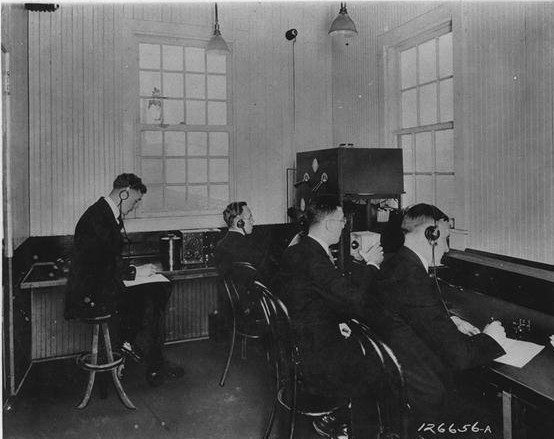
On Tuesday, October 27, 2020, commercial radio will celebrate it’s 100th birthday. It was on this day in 1920 that “the U.S. Department of Commerce, Bureau of Navigation, which served as the radio licensing agency of the day, issued the first radio license ever to KDKA,” as told on the station’s website.
Radio Call Letters
Ironically, those famous Pittsburgh call letters – KDKA – don’t stand for anything. They were simply assigned to the station with its broadcast license from a roster maintained to provide identification for ocean going ships and marine shore radio stations. KDKA just so happened to be the next set of call letters up for being assigned with a broadcast license.
WJJW
This story is analogous to what happened at my college back in the 70s. I graduated with my bachelor’s degree from North Adams State College in 1974. During my four years at NASC, I helped to obtain the college’s FCC FM broadcast license and become its first general manager. I vividly remember standing in front of a classroom blackboard with my fellow college broadcasters trying to decide what call letters we wanted the FCC to assign to our station. During this meeting a knock came to the door, and the person who knocked handed me an important letter from the Federal Communications Commission in Washington, DC. I anxiously opened the envelope to find that the FCC had granted our request for an FM broadcast license and had pulled the next set of unassigned call letters off the roster to go with our license. Those call letters would be “WJJW.” And like KDKA, they would stand for absolutely nothing and there again, never changed.
Call Letters
Some of the radio stations I listened to over the years had call letters that represented something, like WLS & WCFL in Chicago. WLS owned by Sears, chose call letters that stood for “World’s Largest Store” and WCFL, chose call letters that stood for “Chicago Federation of Labor,” the name of their union. WCFL proudly called itself “The Voice of Labor” at the top of every hour when it was required to give its call letters and city of license.
Do you know what the call letters for WKBW in Buffalo and KHJ in Los Angeles stood for? WKBW’s call letters meant “Well Known Bible Witness” and KHJ had call letters that stood for “Kindness Happiness & Joy.” Neither radio station would mention the origin of their call letters during their Top 40 days.
Radio stations I worked for and managed also had call letters that represented something:
- WBEC – Berkshire Eagle Company (the local newspaper)
- WBRK – Berkshires
- WUPE – Whoopee Radio
- WFPG – World’s Famous PlayGround (Atlantic City)
- KOEL – the first three letters of its city of license, Oelwein, Iowa
- WLAN – Lancaster, PA
- WSUS – Sussex, NJ
- WOND – WONDerful Radio (Atlantic City)
- WNNJ – Northern New Jersey
Call letters today tend to have been replaced by other forms of identification, like “Kiss,” “Froggy,” or “The River,” with the only problem being that they’ve lost their unique, one-of-kind identity that call letters branding gave them.
When I say KHJ or WBZ, you immediately know I’m talking about a radio station and that the station is located either in Los Angeles or Boston. When I say “Kiss” or “Froggy” you have no idea of which Kiss or Froggy radio station I’m referring to nor where it is located.
KDKA Covers Its First General Election
Shortly after receiving its commercial broadcast license, KDKA began planning its coverage of that year’s general election results to begin at 6pm on Tuesday, November 2nd, 1920.
Four men would climb to a little shack on the roof of one of the Westinghouse Electric’s buildings in East Pittsburgh to report on the results relayed to that shack via telephone. Leo Rosenburg delivered the results, becoming radio’s first announcer on the first licensed American radio station. You can hear a recreation by Leo of that broadcast HERE
About a thousand people tuned in to hear the broadcast and they would be some of the first people that year to learn that Warren G. Harding had beat James Cox to become the next President of the United States.
Election Night 2020
One hundred years later, election night will be quite different. People will most likely learn of the results via their smartphone, and probably not until all the votes have been counted. Due to COVID-19, we can expect that the vote counting process will take days, or even weeks, before a victor is declared.
Remember, your vote is important. Many recent elections have been decided by the thinnest of margins.
Do your civic duty and please VOTE.
 “There are some things that will scare you so bad, that you will hurt yourself,” said Molly Ivins. And that’s exactly what I believe the radio industry has been doing to itself for most of its 100-year history.
 When television came along and took away radio’s people and programs that were attracting its large listening audience, it was forced to re-invent itself.
 Radio is a business.
 I was reviewing the last FCC report about the number of broadcast stations in America as of December 31, 2018 and in my head I found myself singing a parody of the Bellamy Brothers song, “Too much is not enough.” Only my version was “too much is way too much.”
 There are lots of items in the news these days about what the radio industry should be doing. Streaming, podcasting, smart speaker accessible etc. The one thing I hear little talk about is, improving the core product and focusing on what the listener is seeking.
 There’s something that’s been troubling me for some time. It’s the radio industry’s habit of reporting radio listening results by calling it “AM/FM” versus what it really is, virtually all FM radio listening.
 WTOP was built on AM radio. It moved its entire operation over to the FM band and grew its audience, revenues and lowered its listener demographic. People who never heard this radio station on its AM dial position were suddenly newly minted fans of their all news format.
 From my blogging, I get lots of feedback about a variety of things concerning broadcasting. One reader wrote to me about his father, a sports fan, who turned on WIP-FM to hear the latest chatter. WIP-FM was broadcasting a game of no interest to his father, so his son said to him, why don’t you turn on WIP AM610. Sadly, this person wrote the audio was unlistenable. He wrote: “You’d think the FCC would mandate that AM have standards for audio quality in receivers.”
 When I was living in Bowling Green, Kentucky, I couldn’t receive 650AM WSM in my office, even though my office looked south and my antenna was able to enjoy a full wall of windows. The noise floor both inside my university office as well as around town while driving in my car made the station unlistenable. WSM was once listened to all the way to Louisville in northern Kentucky. Instead, I downloaded WSM’s app and could enjoy the radio station in crystal clear stereo. (I see WSM has stopped subscribing to Nashville Nielsen Audio ratings.)
 The British Broadcasting Corporation (BBC) did a review of the range of services it offered on the AM band (called medium wave across the pond) and it included a financial review of all its services too. They concluded the ROI (return on investment) in AM was not there and announced they would be turning off some 13-AM radio stations in January 2018 according to Radio Business Reports.
 There’s a great radio operator in Cadiz, Kentucky by the name of Beth Mann. WHVO is her AM radio station at 1480, but if you go on her website, you won’t find any mention of this station being on the AM radio dial. It’s promoted as
  Have you heard the latest? People are addicted to their smartphones. “We now see smartphones as dangerous for young minds,” writes Jean-Louis Gassée in a
  On this last Sunday of 2017, it’s a good time to look back at the year just past and share with you The Top 5 Most Read and shared blog articles from 2017. Maybe you missed them or perhaps you’d like to read them again.
 I’ve been attending a lot of radio meetings these past years and one refrain I’ve heard over and over and over and over is that the power of radio is it’s “live & local.”
 I lived in Kentucky for 7-years.
